- Home
- Technical Writing
- Knowledge Work as a Product
Knowledge Work as a Product: Professional Services in the AI Era
By Jack Jin · September 11, 2026 · 12 min read · My Columbus AI Week talk
On September 11, 2026, I gave a fifteen-minute talk on the main stage at Columbus AI Week. My argument: professional services is the industry most exposed to AI, because its product is pure knowledge work, and that makes it the most exciting seat in the house. This is the talk written up, slide by slide: the four truths about what clients buy that still hold, the recommendations built on them that turned into lies, and three new products that firms big and small can sell in 2026.
Back at Columbus AI Week
Columbus makes things
The four truths
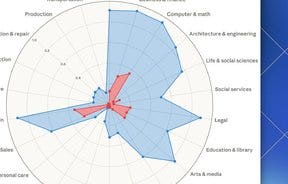
Exhibit A
Old truths, new lies
Start from the customer
Three new products
How, and who
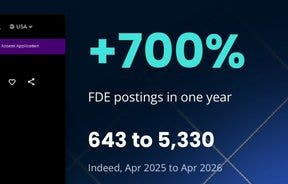
A real job posting
What will you do?
Back at Columbus AI Week
It was great to be back at Columbus AI Week, a year after my first talk there. For my day job I'm a Tech Architecture Associate Director at Accenture, where I've been for eleven years.
Outside of my day job, I do a lot of AI building. I experiment with different AI technologies, watch YouTube videos and build things. I've presented a couple of sessions at AI Tinkerers here in Columbus, and happened to win some of their global weekly awards. Maybe someday my title will change to AI builder.
This talk, however, was the business-friendly one: how AI is transforming professional services.
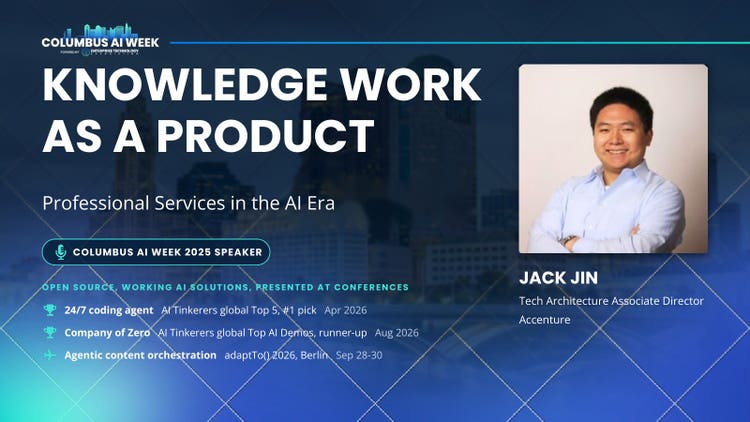
The title slide, with three builds from this year: the 24/7 coding agent, Company of Zero, and the agentic content orchestration talk I gave at adaptTo() 2026 in Berlin later in September.
Columbus makes things. Professional services sells knowledge work
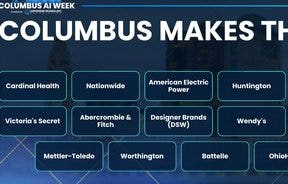
Columbus is home to a lot of industries, and I have a lot of friends who work at these companies: Cardinal Health, Nationwide, AEP, Wendy's, and some really big brands, including Victoria's Secret.
One of my favorite storylines of the year: Victoria's Secret stock was up more than forty percent this year, on unexpected earnings and revenue, from people suddenly wanting to buy newer outfits. And the reason Wall Street gives? Ozempic. An outside force nobody planned for changed the company's revenue substantially. Wouldn't it be great to have your stock go up and lose weight at the same time?
AI can help every company on that wall accelerate its business. But they all have core businesses outside of pure knowledge work. Wendy's has the burgers and the burger brand. Battelle has the patents and the research labs. Cardinal Health has the distribution network. AI is changing things for all of them, but their product isn't made of knowledge work, so the impact has a limit.
Professional services is different. Our product is pure knowledge work: the thing AI produces is the thing we sell. That makes us the most exposed industry in the room, and I think it's the most exciting seat in the house. Everything that follows is my collective thinking from working at my firm, talking to firms of every size around Columbus, and thinking about where professional services is going.
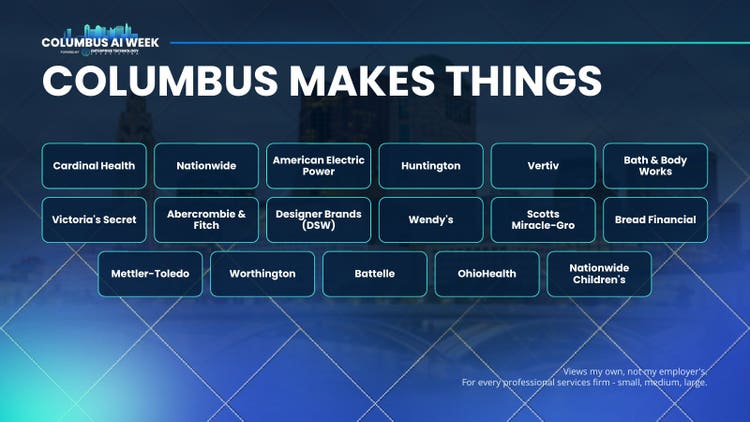
Seventeen companies that call the Columbus region home. The note in the corner: views my own, for every professional services firm, small, medium or large.
The four truths of the professional service product
There are four fundamental truths in what every client buys from professional services. And I'm a consultant, so I'm about to consultant-splain what you're actually buying.
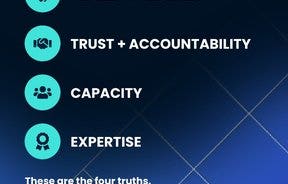
The first is priced to market. Every offering of knowledge work has to be priced right, or you get left on the side of the road very quickly.
The second, and probably the most important, is trust and accountability. Large firms and small firms, we all run on trust. When a firm does sixty or seventy billion dollars a year, you can't just go find new clients, because everyone is already your client. The only way to get the next piece of business is to do great work on the last one and keep building the trust.
The third is capacity. Sometimes a client has the expertise but not the people. They need more hands for a short period, and they don't want to hire full time.
The fourth is expertise itself. I've done one very specific thing my entire career: content management. Or think about investment bankers doing mergers and acquisitions, highly critical to a company's wealth and success. If you make glass, you're not going to become a merger expert. You want the best value out of your acquisition, so you buy the expertise.
These four were true yesterday, and they're still true today. These are the four truths. Everything else is a recommendation.
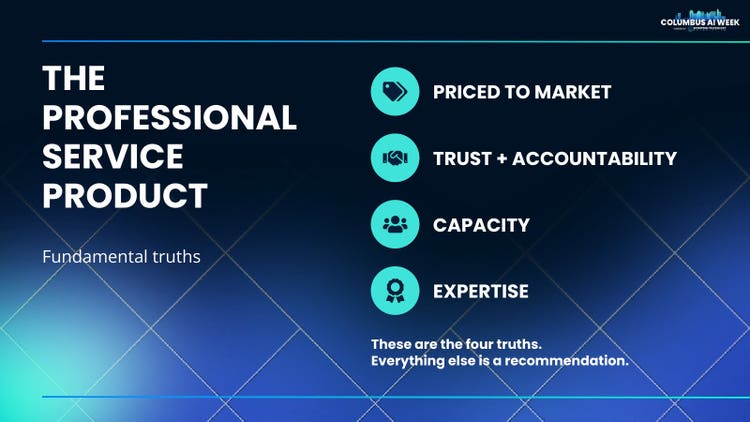
The four truths, and the line I wanted the room to remember.
Exhibit A: AI's theoretical potential
Exhibit A is a chart from Anthropic's March 2026 research on the labor market impacts of AI. It shows the exposure, or as I'd rather say, the opportunity, for our business. The blue is theoretical: what the frontier models already have the capability to do. The red is what's being used today, and it's much lower.
A lot of what we do in professional services is knowledge work, and it falls heavily in the blue. Look where the tallest blue sits: legal, finance, business. The professions. This is not just a coding story.
Two things to keep in mind. First, these numbers are theoretical, and the tool still has to be proven out. Second, human judgment, taste and accountability don't go away.
So we have to do two things at once: be careful with our own governance as we deliver knowledge work with AI, and be very competitive in the new space.
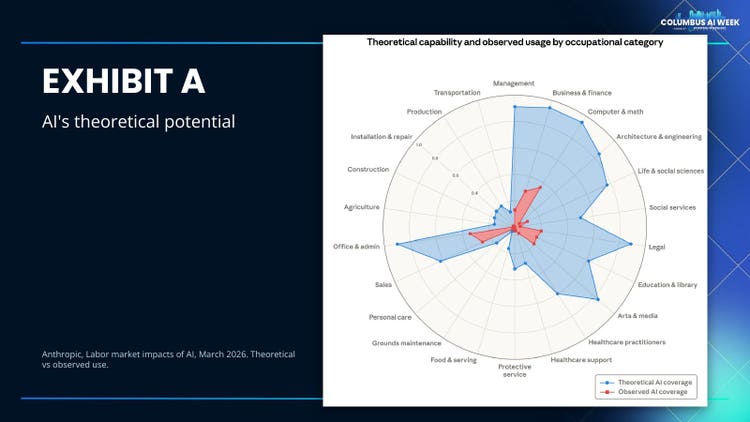
Theoretical capability (blue) and observed usage (red) by occupational category, from Anthropic, Labor market impacts of AI, March 2026.
Old truths, new lies
So what does this much change do to an industry like ours?
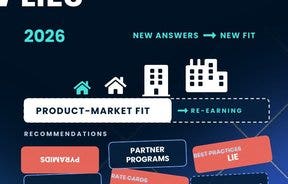
In 2024, I believe consulting firms of all shapes and sizes had perfect product-market fit: McKinsey, Accenture, the big offshore firms that are very price competitive, like Cognizant, and many others. If you'd told me in 2024 that you were raising venture money to compete with Accenture, I would have laughed, because Accenture had perfect product-market fit.
In 2026, things have shifted. The four truths, price, trust and accountability, capacity and expertise, didn't change. But a lot of the recommendations built on top of them to win in 2024 are no longer true. Some still hold. A lot of what used to be true is now a lie, and it's actively hurting the firms still operating as if it were true.
That's a new opportunity for everyone: the firms that adjust quickly win.
We tell our clients all the time that they need to change. They're the ones who need to change; they need us. In reality, we also need to change, because we're now operating on both truth and lies.
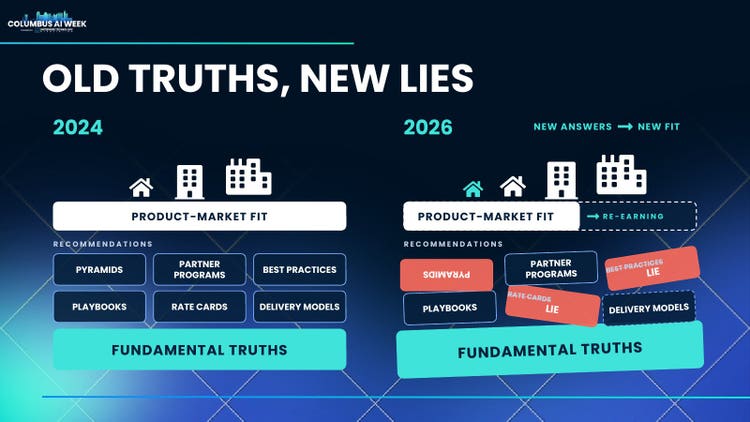
Same truths underneath, product-market fit being re-earned. The slide marks three of the 2024 recommendations in red: pyramids, best practices and rate cards.
Start from the customer, the way Steve Jobs did
So how do we reinvent ourselves? I asked myself the obvious question: what would Steve Jobs do?
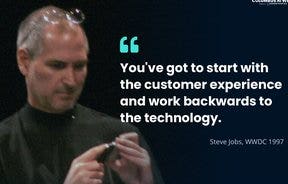
In 1997, Apple was not doing well at all, and Steve Jobs said one of the more profound things in product history: "You've got to start with the customer experience and work backwards to the technology." When everything is shifting, you hold onto your fundamental truths, you start from the customer, and you work backwards from there.
So who is our customer? I don't mean a brand, a logo on a building. I mean a person: someone tasked with buying services to get something done. Even with all the AI in the world, that person didn't change. Still human, with a family, a career, goals in life, and a name that goes on the recommendation. Right now she has a dozen tabs open, comparing firms that all claim the same thing. Overwhelmed and accountable at the same time. Plenty of people in that room were that person.
Her hardest question in 2026: does this firm actually have the AI chops? The big firms have decades of credentials, earned delivering the old way. Has this firm done it with AI? Does it have the skills, the real deliveries, the receipts? Or is it leaning on the brand and the moat of an existing relationship? She needs to know, because she's under pressure to do more with less and to innovate, and picking the wrong partner is not an option.
So we keep the fundamental truths, let go of the outdated recommendations, and start from her.
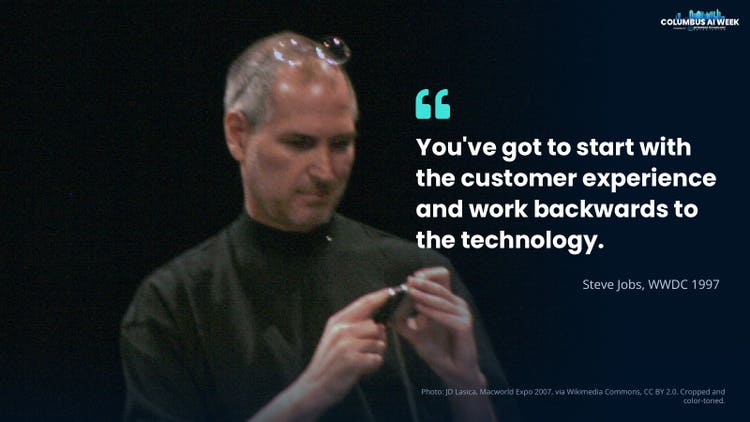
Steve Jobs, WWDC 1997. Photo: JD Lasica, Macworld Expo 2007, via Wikimedia Commons, CC BY 2.0, cropped and color-toned.
Three new products, for firms big and small
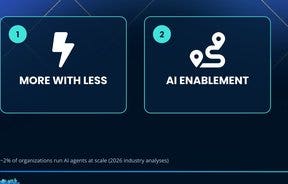
Now that we understand what our customers are looking for, consulting firms big and small need to find new product-market fit. I see three, and a smaller professional services shop here in Columbus that nails even one of them will have very good product-market fit in 2026.
The first is more with less. Clients still buy what they always bought, a data migration, a content migration, a peer review of a legal draft, but now they expect more of it, for less, because AI exists and firms are expected to compete with it and use it properly.
The second is AI enablement. Put yourself in the customer's head: "I'm under pressure from my boss to innovate with AI. How do I do the change management? How do I pick the tools? How do I handle governance? How do I get my whole firm on this journey?" Remember, she makes burgers, or clothing. Getting agentic is not her core business, so helping her get there is a product now. Big firms sell it, and small firms sell it.
The third is new products, and new ways of delivering them. This is where you go back to first principles, to the four truths. Productized knowledge: what you proved at one client, made generic and sold again. New delivery models, all the way to engineers embedded inside the client's own team.
And here's the Steve Jobs part: the new products may cannibalize your existing business. Do it anyway. In a brand new world, we meet the customers where they are, and that's how professional services stays competitive.
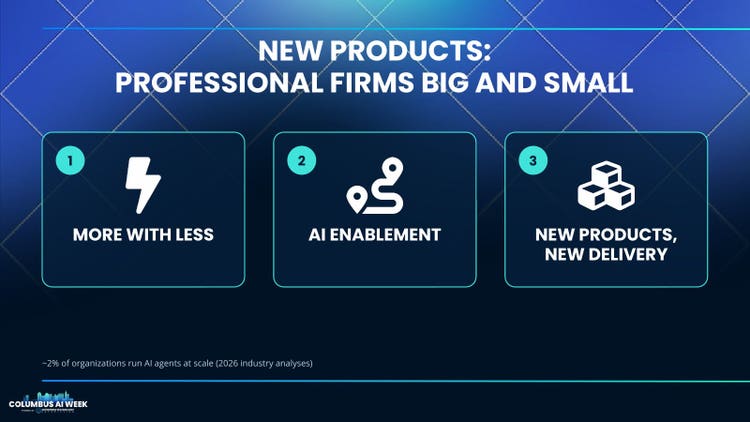
Three ways to new product-market fit. Any one of them is enough for a small firm.
How, and who
So how do firms large and small do these three?
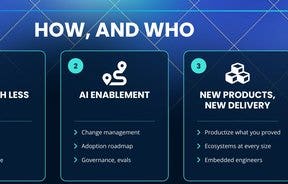
For more with less, a small firm can hire for the fit, or even start the company exactly for it. A bigger firm has to train and retrain the people who already know the business, and upskill everyone. That takes playbooks, case studies and internal learnings. It takes time, and we all need to get there faster than we'd like.
This is also where the silent winners are. The firms doing more with less are capturing the margins silently, and it's the failures that make the news. In March 2026 a breach was reported at McKinsey's internal AI platform, Lilli: about forty-six million chat messages exposed, by someone else's AI agent, in about two hours.
My first thought: somebody messed up. My second thought: if that breach had never made the news, nobody would have known McKinsey had built an agentic brain of how they operate, a platform their 43,000 people use every day. That's our industry right now. Everyone is building without announcing it, and you only hear about it when something breaks. When you don't hear anything, they're probably doing it right.
AI enablement is change management as much as technology: guiding clients on adoption, on governance, on getting their people trained, on harnessing all this responsibly. The real challenge is that the potential is there, but outcomes are all over the place. The same tool gives one team a great result and the next team a mess.
Solving that consistent-outcome problem is the work: evals, meaning repeatable tests of whether the AI's output is good enough, and quality gates. That's how the silent winners can afford to stay silent. They have receipts.
And the demand is real: Accenture and Anthropic formed a joint business group, announced in December 2025, in what felt to me like record time. Everyone is moving.
For new products and new delivery, especially at the established firms: explore new ways of delivering knowledge work. Forward deployed engineers. Different team shapes. Experiment, gather data, learn and evolve, because so much of the ground has shifted.
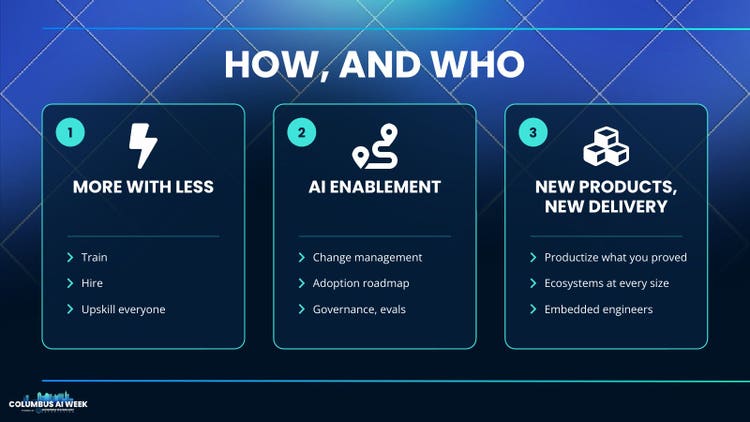
How, and who, for each of the three.
Here are the three products side by side. Pick a lens to read all three on one question.
A real job posting, hiring in Columbus
Here is a real job posting from Accenture, and there are many others like it: an AI Cloud Native Forward Deployed Senior Manager at the associate director level, with Columbus as one of its locations. A forward deployed engineer embeds directly with clients, as both technologist and trusted advisor.
Postings for the role on Indeed grew from 643 to 5,330 between April 2025 and April 2026, more than 700 percent in a year. Firms are hiring it everywhere, and Accenture was hiring it right here in Columbus.
Why is this role a thing? I've been at Accenture for eleven years and in professional services for twenty. We all know the pyramid structure. For the first time, I'm seeing an individual contributor at the associate director level, which is extremely rare. With AI and the way things are changing, we need very senior people at the top, not only to manage but to do the individual work. The belief is simple: AI plus the right capable engineer can do great things, and everyone in the knowledge work space is experimenting with exactly this.
And notice what this posting is: a job being created, not one being replaced. Senior level, in this city. The ground has shifted, and this is what it looks like when it shifts in public.
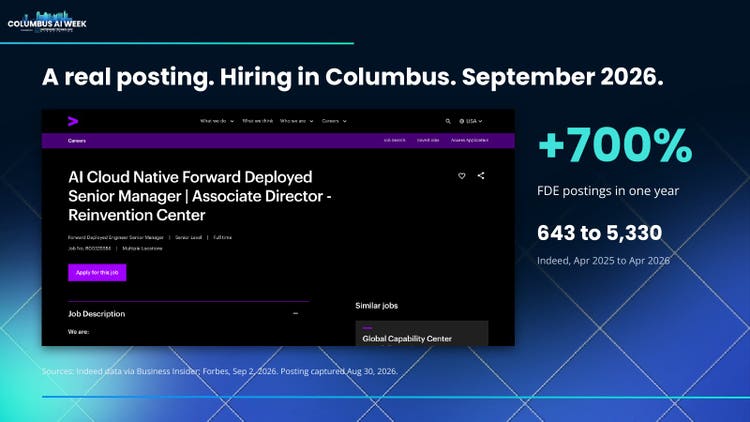
The posting as captured on August 30, 2026. The numbers: Indeed data reported by Business Insider, and Forbes, September 2, 2026.
What will you do?
Here's where I land. I don't believe AI is a competitor. I see AI as a shift, and the shift creates opportunity.
If it weren't for AI, I would have been an associate director at Accenture, very happy with it, and probably either retired that way or moved to an industry role and hung my consulting jacket up. Now I see new paths to trailblaze, at Accenture and perhaps elsewhere.
With AI, I'm going back to being a builder. Not instead of being a leader: I'm still a leader. But for the first time, I don't have to pick one. I'm choosing to embrace the exponential of what I do know, to let AI help me understand and think through what I don't, and to learn from it.
What will you do?
The last slide. Thank you, Columbus.